What separates a real clean from a blow-and-go
Drive through Hendersonville or up toward Flat Rock on a Thursday and you'll pass three crews doing three different jobs. One is cutting grass. One is creating the appearance of cutting grass. On these yards, with bluegrass and fescue pushing fast in May and dormant debris still heavy in March, the difference shows up within ten days.
A real clean means the deck height is set for the season, not left at whatever it was in April. It means string trimming along the foundation, fence line, and mailbox post actually cuts, rather than laying the grass over and leaving a frayed skirt. Edging runs a real blade along the concrete, not just a string bump. Blowing clears the driveway, walk, and gutter line, not just the middle of the turf. A blow-and-go hits the visible acres, pockets the difference, and leaves the detail work for you on Saturday.
That distinction is also what the price reflects. Most Henderson County homeowners pay $45 to $75 per visit on a biweekly plan, which averages $120 to $260 a month for a mow, trim, edge, and blow on an average fenced or half-acre yard. A bid that undercuts that band usually has one adjustment baked in: less time on the edges.
You can see it in the fringe. A crew that's rushing leaves a mohawk along the chain-link where the string trimmer only caught the top third of the grass. It leaves an uncut collar around the mailbox post, a ring of taller blades that the mower deck couldn't reach. It leaves clippings piled in the gutter line at the street, which the next hard rain pushes into the storm drain. These aren't cosmetic complaints. On a sloped lot where the mower deck is already struggling to hold a line, the trim work is the only thing keeping the edges from looking ragged. And ragged edges are what neighbors notice first.
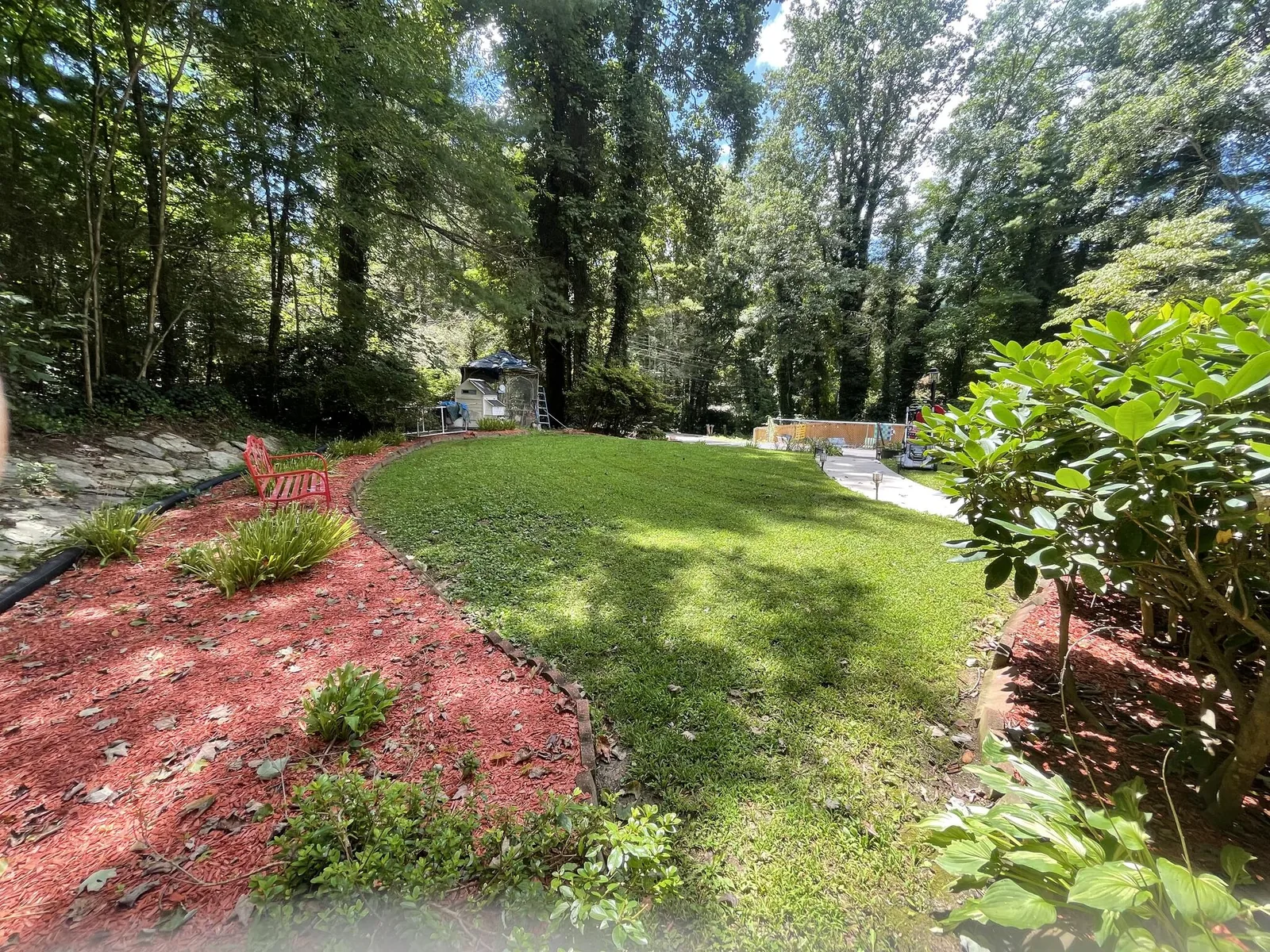
On the Etowah and Horse Shoe valley lots, the ground is often flatter and the crew can run a ride-on mower across most of the turf. On the terraced yards climbing toward Saluda or the wooded parcels near DuPont State Forest, the crew is on a walk-behind or a push mower for most of the job, and the trim work around retaining walls and stone borders adds lineal feet that a flat lot doesn't have. No honest crew quotes those two yards the same, and no homeowner should expect them to be.
The range you'll see on a Henderson County lot
Henderson County yards are not lawn-flat. Between the valley lots around Horse Shoe and Etowah, the terraced yards climbing toward Saluda, and the shaded parcels under hardwoods near DuPont, mowing time swings widely for the same nominal square footage. A half acre on a slope takes substantially longer than a half acre on a valley floor, and no honest crew quotes them the same.
| Scope of work | Typical monthly range | What drives it |
|---|---|---|
| Biweekly mow, trim, edge, blow — average valley lot | $120 – $185 | turf area, gate access, clipping disposal |
| Biweekly plan, sloped or terraced yard | $165 – $230 | slope grade, push vs. ride, trim lineal feet |
| Weekly mow during peak spring flush | $185 – $260 | growth rate, extra visits, cleanup after |
| Mow plan plus bed weeding and shrub trim | $220 – $260 | bed square footage, plant density, mulch depth |
| One-time catch-up on an overgrown yard | quoted per visit, toward top of band | height before cut, bagging, hauling |
Those are working ranges, not quotes. Two lots on the same street can land on opposite ends depending on how many times the crew has to reposition a walk-behind or dump a bagger. The visit-level math is broken out in our mowing cost guide if you want to price a single cut rather than a monthly plan.
Access matters more than square footage in a lot of neighborhoods. A gate that's 36 inches wide means the crew is pushing a mower through it instead of driving, and a yard with a single narrow entry point adds minutes to every visit. A fence line with mature shrubs planted tight against it means the trimmer has to work around branches, not just grass. A driveway that's long and gravel means the blower has to cover more ground. None of those things show up on a plat map, but they all show up on the invoice.
Clipping disposal is another line homeowners overlook. If the crew bags and hauls, that's a cost. If they mulch the clippings back into the turf, that's cheaper but can leave clumps in thick spring growth. Ask which method the price includes, because switching from mulch to bag mid-season can change the monthly number.
Why spring and fall pull the number around
In this county, a lawn plan is really two plans. From roughly March into June, fescue and bluegrass in the Hendersonville area grow fast enough that biweekly service starts to show scalped, tufted rows between visits, and many homeowners step up to weekly for that stretch. The monthly cost climbs accordingly, then settles back down as growth slows in the heat of July and August.
Then fall arrives, and the leaf load off the hardwoods around Flat Rock and Laurel Park is the real test of whether a mow-and-blow plan is worth its price. Leaves pile faster than any mower deck can handle once they mat, and a crew that only runs a mower will leave a brown blanket smothering the fescue underneath. If you're budgeting for fall honestly, price leaf work as its own line item rather than assuming the mow plan absorbs it — our leaf removal cost guide covers what that adds on wooded lots. The National Weather Service office in Greenville-Spartanburg tracks the frost and freeze timing that ends the growing season here; the first hard freeze is what turns a lush yard into a cleanup job overnight (NWS).
There's a shoulder season in late February and early March that catches a lot of homeowners off guard. The grass hasn't started growing yet, but the winter debris has. Sticks, acorns, and leftover leaves from the fall are still on the ground, and the first mow of the season has to deal with all of it. A crew that shows up with a mower and nothing else will either leave the debris or spend twenty minutes raking it by hand. Ask whether the first spring visit includes a debris pass, because it changes the time on site.
Summer drought is the other swing factor. When Henderson County gets a stretch of dry weather in July and August, growth slows to almost nothing and some homeowners drop back to a three-week schedule or pause service entirely. That's a reasonable call, but it's also when the turf is most stressed and least able to recover from a scalping. A crew that knows the local pattern will raise the deck height in the heat instead of cutting low, which keeps the roots shaded and the lawn alive until the fall rains return.
What the law and code say about lawn chemicals here
Most mowing plans are mechanical and stay clear of regulation, but once a crew applies fertilizer or weed control as part of the service, different rules apply. The North Carolina Department of Environmental Quality oversees pesticide and nutrient management in the state, and its guidance on lawn and turf applications is worth knowing if you're paying for treatments (NC DEQ). The U.S. Environmental Protection Agency sets the federal label rules that govern every product a lawn technician can legally apply, including timing restrictions (EPA).
For structural work on a yard — retaining walls, drainage, irrigation tied into a building — the North Carolina Department of Insurance and the state Building Code Council administer the residential code that local inspectors enforce (NC DOI). If a landscaper proposes wall or drainage construction and waves off permitting, that's a sign to slow down. Purely cosmetic mowing and trimming does not require any of this.
One local wrinkle: Henderson County sits in a part of the state where nutrient management rules for turf can be stricter than what homeowners expect, especially near waterways that drain into the French Broad or the Green River watershed. A lawn service that applies fertilizer without knowing those boundaries is a risk you don't need to take. Ask what products they use and whether they check local restrictions before they spray.
If your yard has a septic drain field, that's another spot where mowing and chemical application intersect. The county health department has opinions about what can be planted and applied over a drain field, and a crew that doesn't ask where the lines run is a crew that might drive a mower over the tank lid or spray weed killer on ground that drains straight into the system. It costs nothing to point out the layout on the first visit.
Keeping the monthly number honest
Three habits protect a homeowner here:
- Ask for a per-visit price, not just a monthly. A monthly figure that hides a planned skip week or a reduced fall schedule looks cheaper than it is. Per-visit pricing keeps the comparison clean and lets you trim the service seasonally.
- Spell out what the visit includes. Confirm in writing that trim, edge, and blow are part of every visit, not add-ons. The most common complaint in this market is a plan priced for mowing only and billed for the rest.
- Compare against the local band. If a monthly quote falls far below $120, ask what got dropped. If it lands far above $260 for a standard yard, ask for a line-by-line breakdown of turf area, slope, and trim footage.
For the full picture of plan options and what each tier covers, start with our lawn care overview before you sign anything.
One more habit that saves money over a season: take a photo of the yard on the day you sign and another after the first visit. If the edge along the driveway doesn't look different in the second photo, the crew isn't edging. If the fence line has a skirt of uncut grass, the trimmer isn't reaching. Photos are the cheapest quality control you have, and a crew that knows you're checking tends to keep the standard up.
And if you're comparing two quotes and one is dramatically lower, ask the lower bidder what their visit looks like from the street. If they can't describe the trim and edge pass in specific terms, they're pricing a mow, not a lawn care plan. On a Henderson County lot with any slope or shade, that difference shows up by the second visit.