What actually lands on East Flat Rock roofs, and when
East Flat Rock is a Henderson County mill village that grew up around the old textile plant and never really left the trees. Big hardwoods hang over a lot of the housing stock here, and those trees run a debris calendar that most homeowners never think to write down. Late March through April drops oak catkins and tassels — small, light, and they sift straight through gutter guards. Through May and June the pines and sweetgums shed pollen and seed pods that cake into the valleys. Then fall throws the real load: oak and hickory leaves, plus the sycamore and tulip poplar litter that comes off the Green River corridor west of town.
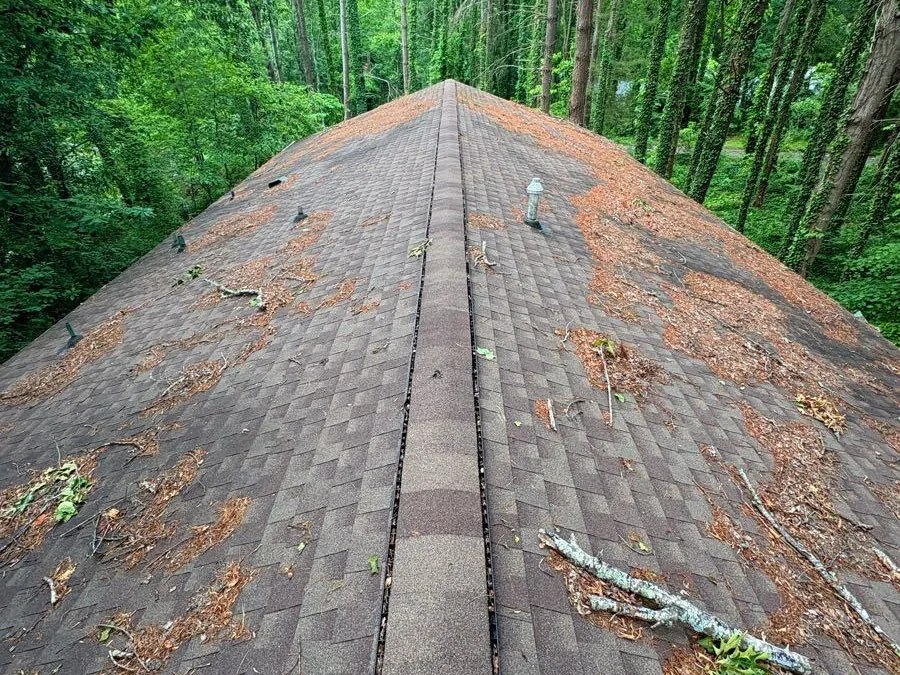
The problem is what winter does with that pile. Moss establishes in the shaded north and west plane of a roof, holds moisture against the shingles, and by the time you notice a green tint, it has already lifted the shingle edges it grew under. If you want the fuller service picture, our roof cleaning and moss treatment overview walks through what soft-wash versus hand removal actually means for a shingled roof.
What makes East Flat Rock different from a lot of Henderson County is the sheer density of mature hardwoods on modest lots. This isn't a town of open, sunny acreage. It's a town where a 1950s mill house sits under two or three 80-year-old oaks and a hickory, with a sweetgum volunteering at the property line. That canopy is beautiful in July and a maintenance obligation by November. The same trees that shade the porch also shade the roof for most of the day, and roof shade is the single biggest predictor of moss. A roof with four hours of direct sun dries out between rain events; a roof with one hour stays damp.
The valley problem: why this town gets both moss and mildew
East Flat Rock sits low relative to the ridgelines that ring it, which means the town collects the cool damp air that drains off the surrounding slopes overnight. Combined with the region's storm record — 16 federal disaster declarations have touched this county across 1978-2026 — that moisture is the constant, not the exception. Growth that would take a decade on an open ridge lot can colonize a shaded valley roof in two or three seasons.
The National Weather Service keeps a running picture of how much rain and storm activity this part of North Carolina absorbs at weather.gov, and it lines up with what we see on roofs: algae streaking on the north-facing planes, black mildew on the fascia, and moss that comes back every year unless the underlying shade and moisture are addressed.
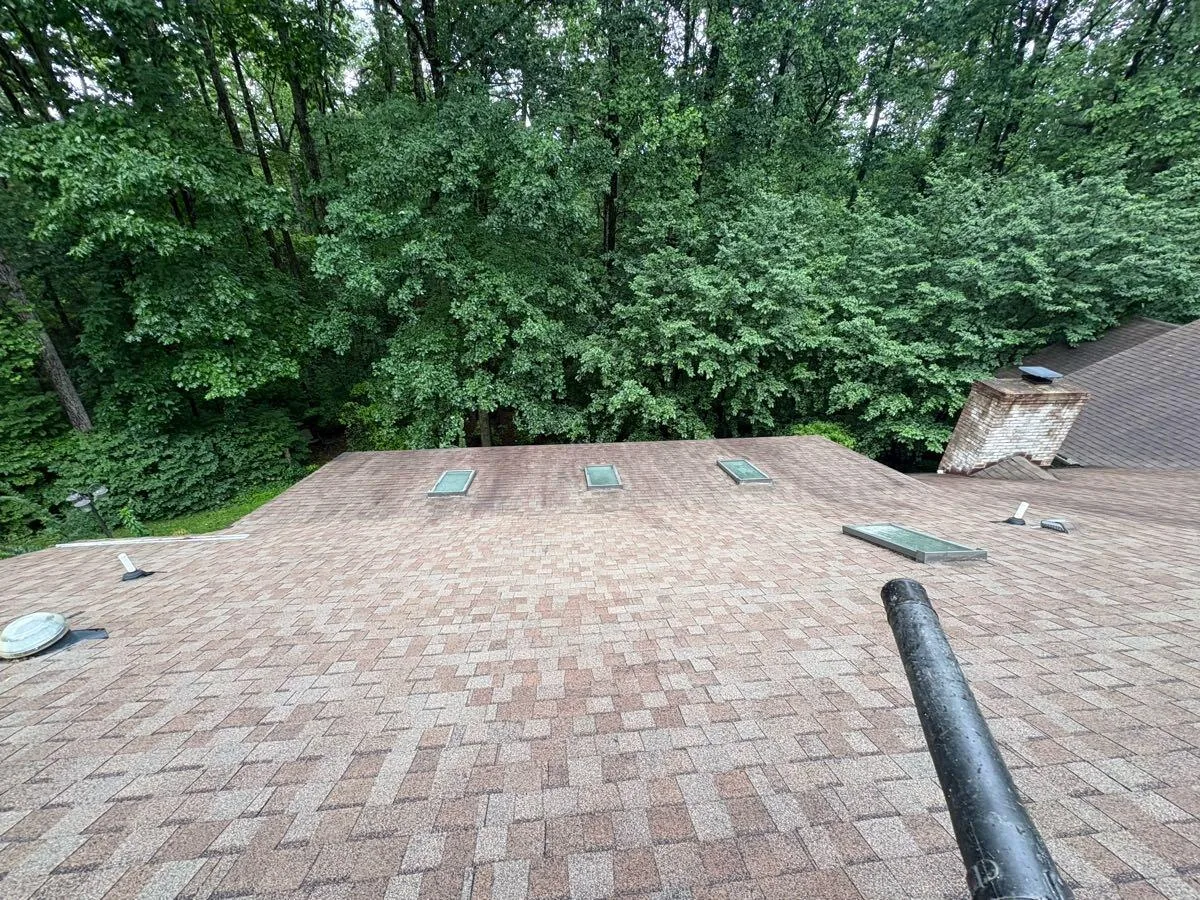
There is a second, quieter issue that comes with the valley position: morning dew. In spring and fall, East Flat Rock roofs can be wet until ten or eleven in the morning from dew alone, long after the ridge-top houses have dried. That extended wet window is what feeds the black algae streaking that shows up as dark stains on asphalt shingles, especially on the north and east planes that never get strong afternoon sun. Algae isn't moss and it isn't structural the way moss is, but it's the early warning sign that a roof is staying wet too long, and it usually precedes the moss by a season or two. If you're seeing dark streaks and no green yet, you're at the cheap end of the pricing band — that's the time to act, not wait for the moss to show.
Scope and price ranges
Every house is different, but the same handful of line items show up on nearly every East Flat Rock job. Here is how the work typically breaks down before anyone walks the roof.
| Scope | Typical range | What drives it |
|---|---|---|
| Single-story, light debris, no visible moss | $450 – $650 | Square footage, easy pitch, one-story access |
| Two-story with gutter clearing and rinse | $650 – $900 | Height, gutter run length, downspout count |
| Heavy moss, needle pack, or steep pitch | $900 – $1,200 | Manual moss removal, valley clearing, safety rigging |
| Recurring treatment after first clean | Top of the band each visit | Shade load, tree proximity, roof material |
Gutters are usually part of the conversation, because a cleaned roof dumping into a clogged gutter just pushes the water problem to the fascia. Henderson County gutter work has its own pricing, and our gutter cleaning cost breakdown for Henderson County lays it out if you want to bundle the two.
A note on how to read that table: the line you land on is driven mostly by access, not by roof size. A long single-story ranch with a 5/12 pitch is far cheaper to clean than a small two-story with a 10/12 pitch, even though the ranch has more square footage. Steep pitches need rigging and slower, more careful movement, and that labor is what pushes a job toward the top of the band. Heavy moss adds a manual removal stage on top of the cleaning, which is why a mossy roof can cost roughly double a clean one of the same size. If you want a real number rather than a range, the only honest way to get it is a walk of the actual roof — pitch, access, moss coverage, and gutter condition all have to be seen.
What a proper moss removal looks like
Moss does not come off with a pressure washer and a good attitude. Pressure washing a shingle roof strips the granules that protect it and shortens the roof's life, which is exactly the opposite of what you paid for. The correct sequence is manual removal of the moss mat with a soft-bristle tool, clear the valleys and ridge lines, then apply a treatment that kills the remaining spores and slows regrowth.
Anyone doing chemical treatment on a roof should be working within federal pesticide labeling law and the manufacturer's directions — the EPA's pesticide program guidance at epa.gov is where the authority on that sits. A crew that can explain what they're applying, at what dilution, and why is a crew that will not stain your siding, kill your shrubs, or wash runoff into the storm drain. It is also worth confirming they carry general liability coverage before anyone gets on the roof.
The reason hand removal comes first, before any treatment, is that a living moss mat is mostly water by weight and it acts like a sponge against the shingle surface. Spraying a treatment onto a thick mat kills the moss but leaves the mat sitting there, still holding moisture, still lifting shingle edges, until it eventually dries and sloughs off — often taking granules with it. Pulling the mat first and treating the remaining spores and root fragments is what actually resets the roof. What you're buying is not just a cleaner-looking roof this month; it's a slower regrowth curve over the next two or three seasons. That's the difference between a maintenance schedule and a repeating emergency.
Roofs and yards are one system here
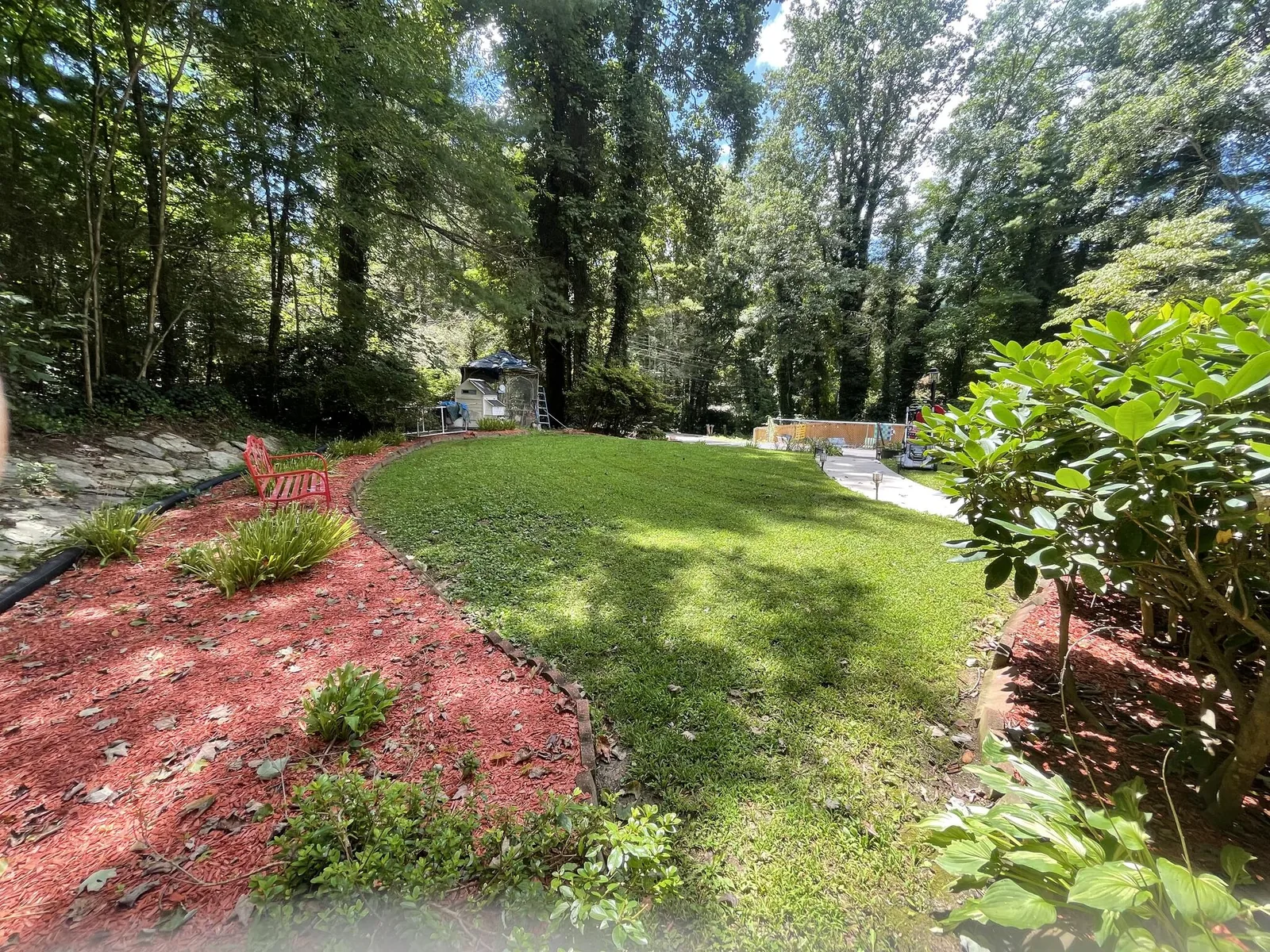
On an East Flat Rock lot, the roof, the gutter, and the ground are wired together. Water that sheets off a mossy roof overflows the gutter, pools at the foundation, and turns a shrub bed into a mud pit by February. That is why our property care work overlaps — the same walk that finds the mossy plane usually finds a gutter that needs re-pitching or a bed that needs regrading. You can see how we handle the whole property at our East Flat Rock landscaping page, and it is often cheaper to solve both problems on one visit than two.
The practical takeaway: get the roof cleaned on a schedule tied to your trees, not to your calendar. Two cleanings a year — one after spring pollen, one after leaf drop — keeps a shaded East Flat Rock roof out of the expensive category. One cleaning every three years puts you at the top of the band with moss damage on top of it.
There is also a safety dimension to the neglect side of this that's easy to wave off until it isn't. A gutter packed with wet leaf litter and pine needles is heavy, and a fascia board that's been holding standing water for a couple of seasons is soft. Rotting fascia is what lets a gutter section pull loose, and a loose gutter full of water is a falling hazard for whoever walks the roof next — homeowner or crew. The National Weather Service's wind and storm outlook at weather.gov is a reminder that this county gets the kind of wind events that turn a loose gutter into a projectile. None of that is a reason to panic, but it's a reason to look at the fascia during any roof walk rather than after the fact.