What actually moves the price on a Laurel Park bed
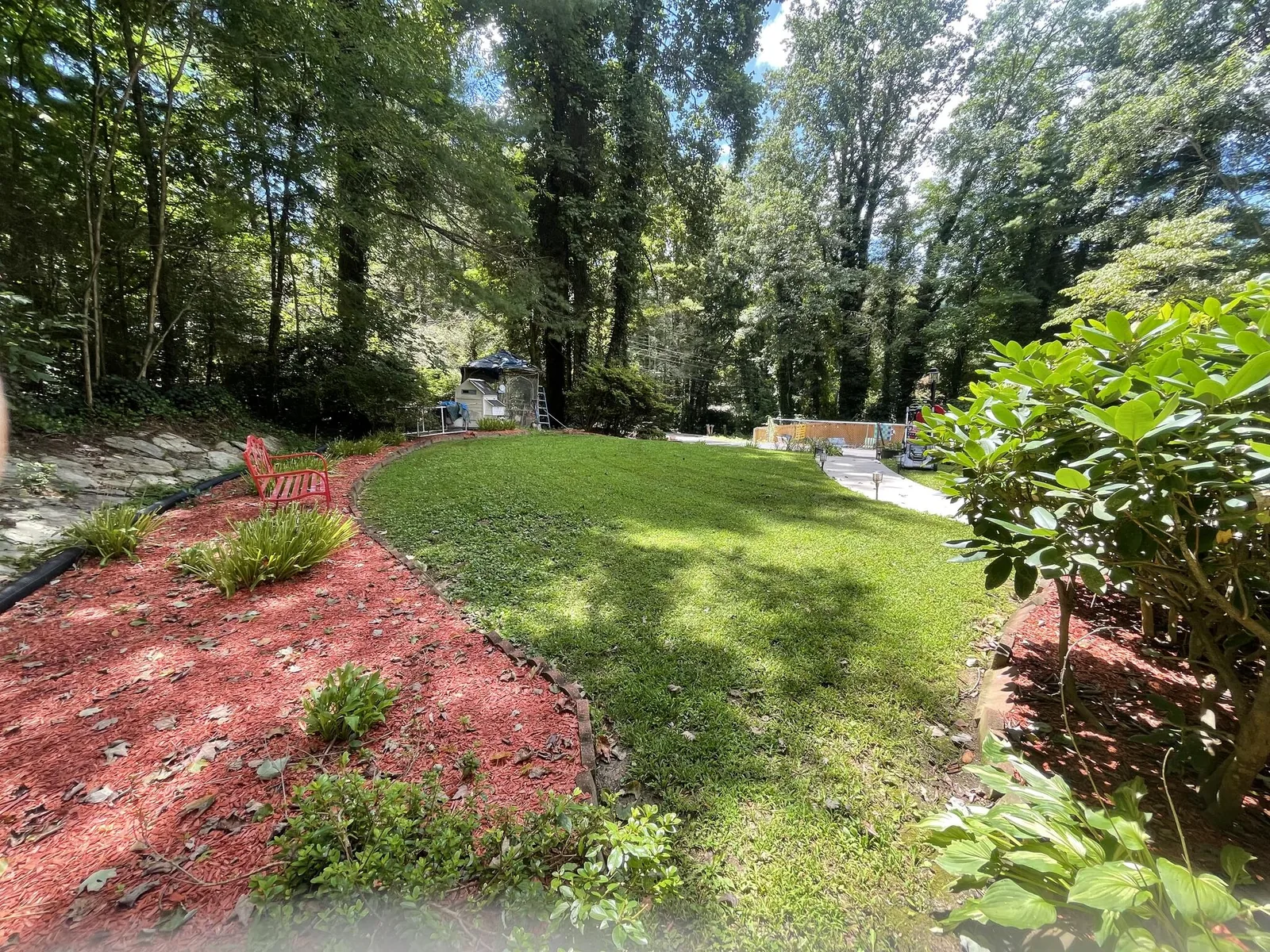
Laurel Park is a small town of wooded hillsides inside Henderson County, draped with mature white oak and hickory canopy, and most of its homes sit on ground that tilts. That matters for a mulch quote more than the material cost. A flat half-acre lot in the valley can take a truck-backed delivery and a wheelbarrow spread; a laurel-lined drive off Laurel Park Highway may need a smaller load, longer hose runs, or hand-carrying up a walkway. Every one of those steps adds labor hours, and labor is what changes the invoice.
The line items that show up honestly on a Laurel Park quote: cubic yards of material, bed prep and edging, weed suppression, depth to the correct two-to-three-inch finish, plant crowns kept clear, and clean-up of driveway and gutter line. A bid that lists only "mulch" is a bid that will grow once the spreader hits the slope.
Consider a specific example: a split-level on a laurel-lined drive just off the main corridor, where the bed wraps a retaining wall and steps down toward the street. That bed might measure 400 square feet, but the crew cannot back a truck to it. Every yard comes up the walk in a wheelbarrow, and the down-slope edge has to be re-cut by hand. The material is the same as a flat-lot job; the labor is half again as much. That is why two quotes for the same square footage can differ by hundreds of dollars and both be honest.
Another local factor: many Laurel Park properties sit on wells and septic, so heavy equipment cannot always leave the drive. Where a mini-skid can't fit, hand work is the only option, and that shows up as a higher per-yard rate, not a padded material charge. Ask any estimator how the material gets to the bed. The answer tells you most of what you need to know about the quote.
For current official guidance, see the U.S. Environmental Protection Agency (EPA). For current official guidance, see the U.S. Department of Housing and Urban Development (HUD).
A working price table for Henderson County beds
These are the honest working ranges for typical residential scope. Material type (double-shredded hardwood, dyed, pine bark fines, natural wood chips) moves the number inside the band, but rarely pushes it out.
| Scope | Typical range | What drives it |
|---|---|---|
| Small front bed refresh (2–4 cu yd, no edging) | $450–$700 | Access, existing weed load |
| Standard ranch-style full-perimeter refresh (5–8 cu yd, edged) | $700–$1,200 | Linear feet of edge, depth correction |
| Steep or wooded lot with hand-carry (per cubic yard) | $95–$130 | Slope, distance, staging |
| Overgrown bed re-condition (leaf litter removal, weed pull, then mulch) | Refresh range plus labor | Condition, not size |
| Playground or natural wood chip install | $85–$130 per cu yd installed | Chip grade, depth spec |
The mulch installation guide covers how cubic-yard math lands on a real bed. In practice, most Laurel Park homeowners fall into the middle row: a full-perimeter refresh on a ranch or split-level, edged, landing between $700 and $1,200 depending on how much old material has to come out and how much edge has to be re-cut. Jobs that come in at the low end usually have clean, defined beds already; jobs at the top end usually involve pulling matted leaf litter and re-establishing an edge that has grown over.
It helps to know what is not in these numbers. They assume the beds are empty of shrubs you want kept and that no new plantings are going in. If you are adding azaleas, rhododendrons, or a privacy screen at the same time, the mulch line stays the same but the overall ticket rises. That is why we quote the refresh separately from any planting, so you can see exactly what the mulch costs on its own.
Why water flow drives the seasonal timing here
Henderson County's federal disaster record is dominated by storm and flood events — 16 declared events across 1978-2026 — and Laurel Park's hillside terrain funnels that water hard. A properly mulched bed absorbs and slows runoff; a three-inch mound pushed against a foundation wall or tree flare holds moisture where you don't want it. The U.S. EPA's watershed guidance is a good plain-language reminder that what happens on a slope lot in Laurel Park lands on the neighbor below. We time installs before the summer storm pattern and after the fall leaf drop, and we tell clients when a bed is a drainage problem wearing a mulch costume.
Gutters tie into this directly: downspout discharge that dumps into a bed will wash mulch onto the drive by July. The Henderson County gutter cleaning cost page explains why clearing the run before the mulch goes down saves a callback.
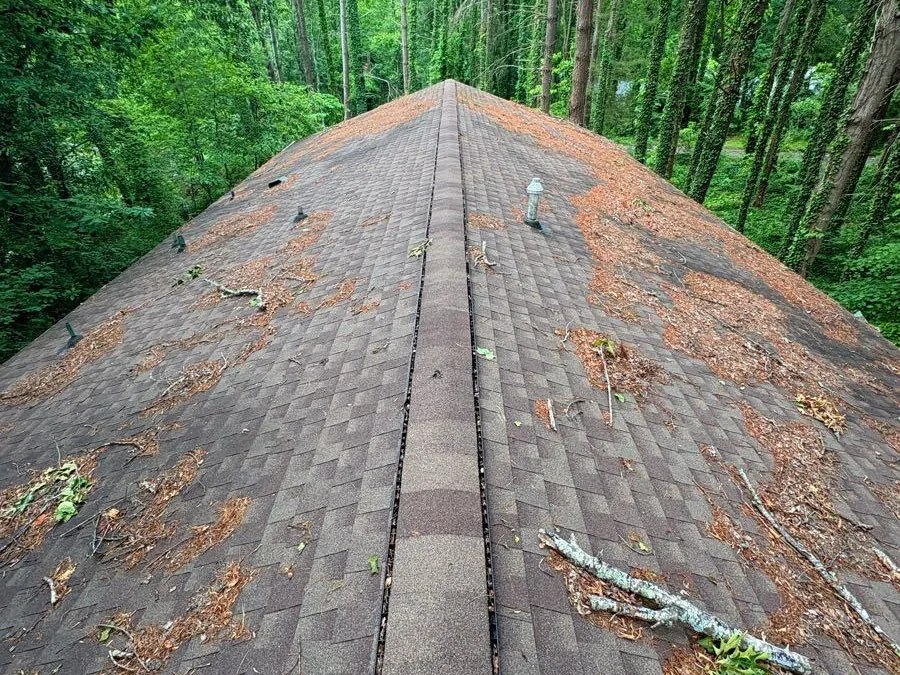
There is a second water issue unique to the wooded lots here: leaf litter. Oaks and hickories drop heavily through late fall, and if that litter is left on the bed it mats down into a water-shedding crust. Mulch spread over a matted leaf layer looks fine in spring and turns sour by August. The fix is to pull the litter back first, which is why an overgrown bed is quoted as refresh range plus labor rather than simply a thicker spread. A bed that drains properly holds its mulch color and depth far longer than one where water ponds behind a leaf dam.
Material choices that hold up under Carolina canopy
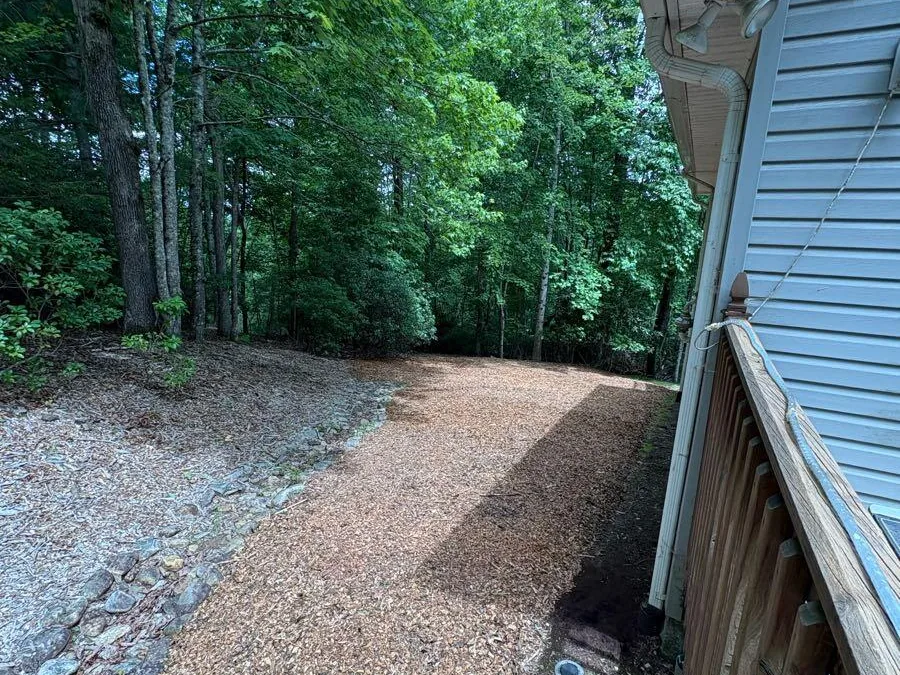
Laurel Park's oak and hickory litter is acidic and heavy. Double-shredded hardwood breaks down fastest and feeds the soil; pine bark fines are the classic choice for azalea and rhododendron beds common around town; dyed mulch holds color longest but adds nothing back. Natural arborist wood chips are the workhorse for path edges and naturalized areas and sit at the lower end of the per-yard band. The NWS climate pages for the Western North Carolina mountains confirm the wet, mild pattern that keeps decomposition active nearly year-round — meaning a two-inch top-dress beats a four-inch mound most seasons. Nothing we install is code-regulated, but the same care that governs landscape work near utilities, per the ICC framework, applies to any digging you do around the bed.
For a Laurel Park property, the practical pairing is usually this: pine bark fines or a fines-and-hardwood blend for the foundation beds where acid-loving shrubs grow, and natural wood chips for the path edges, tree rings, and the naturalized margins where the lawn gives way to woods. Dyed mulch makes sense in one situation only, and that is a bed that gets full afternoon sun and needs to hold color through a long, wet summer. In shade, which is most of Laurel Park, the dye buys you little and the breakdown still happens on schedule.
Depth is the other half of the choice. Two to three inches is the target nearly everywhere. Deeper than that and you smother surface roots, hold moisture against trunks, and create the very rot and pest problems mulch is supposed to prevent. Around the base of a mature oak or hickory, pull the mulch back from the flare entirely. On a slope, a slightly rougher surface texture grips better and resists washing, so a coarser chip can outperform a fine shred in the steepest beds.
Scheduling and property-care rhythm
The best mulch installs happen in late spring, after the last frost and before the summer storms, or in early fall so the bed settles ahead of leaf drop. On the wooded lots here, one annual refresh plus a mid-season top-dress on high-traffic beds keeps things clean. If you want mulch folded into a broader plan for the property, the Laurel Park landscaping page shows how mulching, pruning, and bed maintenance sequence together. For the safety side of any work near utilities or slopes, the NC Office of State Fire Marshal publishes plain guidance at ncosfm.gov.
In real terms, the calendar runs like this. Late March through April, after the last hard freeze, is prime time for a refresh before the canopy leafs out and the ground warms. If you miss that window, early to mid-fall is the next best slot, timed so the bed is settled before the oaks start dropping in earnest. The worst time to schedule is right in the middle of leaf fall, because a fresh bed catches every leaf and the first hard rain presses it all into the new mulch. Homeowners who wait until after leaf drop and then have us clear first get the cleanest result for the least labor.
For a whole-property rhythm, most Laurel Park homes do well on one full refresh a year with a light top-dress on the front beds in between. Beds under heavy oak canopy may want the fall leaf pull as a separate visit so the mulch stays fresh rather than buried. If mulch, gutter work, and pruning are all on the list, sequencing matters: gutters first so the beds below stay clean, mulch next, and pruning last so the trimmings don't land on a fresh spread.